Grammar Focus
Nouns (Ουσιαστικά)
Nouns (Ουσιαστικά) are words that name people, animals, places, things and ideas. First we learn nouns in general, then singular/plural forms, and after that countable and uncountable nouns.
1. What are Nouns? (Τι είναι τα ουσιαστικά;)
Τα nouns είναι οι λέξεις που ονομάζουν ανθρώπους, ζώα, πράγματα, μέρη ή ιδέες. Με απλά λόγια: όταν λες ποιος, τι ή πού, χρησιμοποιείς ένα ουσιαστικό.
✨ Examples (Παραδείγματα)
| Category | English | Greek |
|---|---|---|
| Person | teacher, doctor, Maria | δάσκαλος, γιατρός, Μαρία |
| Animal | dog, cat, elephant | σκύλος, γάτα, ελέφαντας |
| Place | school, park, London | σχολείο, πάρκο, Λονδίνο |
| Thing | book, chair, pencil | βιβλίο, καρέκλα, μολύβι |
| Idea / Feeling | love, happiness, peace | αγάπη, χαρά, ειρήνη |
📚 Types of Nouns (Είδη Ουσιαστικών)
- Common Nouns: γενικά πρόσωπα/πράγματα — boy, car, city.
- Proper Nouns: συγκεκριμένα ονόματα — Maria, London, Tuesday.
- Concrete Nouns: μπορούμε να τα δούμε/αγγίξουμε — apple, rain.
- Abstract Nouns: ιδέες ή συναισθήματα — happiness, love.
- Countable & Uncountable: apple / milk.
- Singular & Plural: cat / cats.
🧠 Examples in Sentences
- The dog is sleeping. → Το σκυλί κοιμάται.
- I love music. → Μου αρέσει η μουσική.
- My school is near the park. → Το σχολείο μου είναι κοντά στο πάρκο.
- This chair is very old. → Αυτή η καρέκλα είναι πολύ παλιά.
🌟 Mini Quiz
Which are Proper Nouns? 👉 dog, Athens, school, Mary, teacher
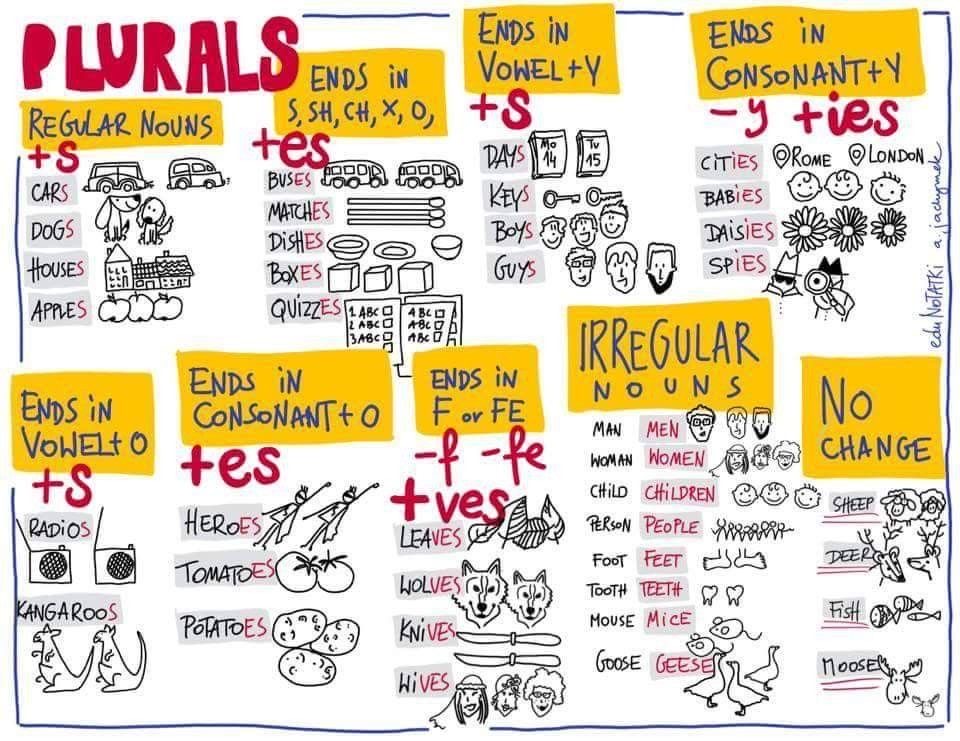
2. Singular and Plural Nouns (Ενικός & Πληθυντικός)
Singular = ένα άτομο, ζώο ή πράγμα (a cat). Plural = περισσότερα από ένα (two cats).
🧮 Rules (Κανόνες)
| Rule | Examples |
|---|---|
| 1. Add -s | book → books, car → cars |
| 2. -s, -ss, -sh, -ch, -x, -z → +es | bus → buses, box → boxes, brush → brushes |
| 3. consonant + y → -ies | baby → babies, city → cities. If vowel + y: toy → toys. |
| 4. -o → usually +es | tomato → tomatoes, but photo → photos. |
| 5. -f / -fe → -ves | leaf → leaves, knife → knives. Exception: roof → roofs. |
| 6. -us → -i | cactus → cacti, focus → foci |
| 7. -is → -es | analysis → analyses |
| 8. -on → -a | phenomenon → phenomena |
| 9. -um → -a | datum → data, curriculum → curricula |
| 10. Irregular / special plurals | man → men, woman → women, child → children, tooth → teeth, mouse → mice, person → people. Same form: sheep, deer, fish, series, species. Always plural: trousers, scissors, glasses, jeans, shorts. |
🌟 Mini Quiz
Write the plural: leaf, potato, toy, woman, bus, fish.
3. Countable & Uncountable Nouns (Μετρήσιμα & Μη Μετρήσιμα)
🧮 Countable Nouns (Μετρήσιμα)
- Μπορούν να μετρηθούν: one apple, two apples
- Έχουν ενικό και πληθυντικό.
- Στον ενικό παίρνουν a/an: a biscuit, an egg.
- Μετριούνται με some, many, a few, a lot of.
Examples: I’ve got a lot of friends. • There aren’t many potatoes left.
How many…? How many children are there in your class?
☕ Uncountable Nouns (Μη Μετρήσιμα)
- Δε μετριούνται κομμάτι-κομμάτι: water, milk, rice, sugar, money, time.
- Έχουν συνήθως μόνο ενικό και δεν παίρνουν a/an.
- Χρησιμοποιούν some, a lot of, little, a little.
- Στην άρνηση/ερώτηση συχνά: any, much.
Examples: There is a lot of milk in the fridge. • We haven’t got much coffee.
How much…? How much time have we got?
📘 Comparison (Σύγκριση με μια ματιά)
| Countable | Uncountable |
|---|---|
| many, a few, how many | much, a little, how much |
| There are some apples. | There is some milk. |
💡 Measurable quantities for uncountable nouns
Για να «μετρήσουμε» μη μετρήσιμα ουσιαστικά, χρησιμοποιούμε ποσότητες:
- a glass of water
- a bottle of milk
- a piece of bread
- a bowl of rice
- a cup of tea
⚠️ Attention: We say some bread or a piece of bread, not a bread. We say How many apples? but How much milk?
✨ Few / A few – Little / A little
| Expression | Meaning | Example |
|---|---|---|
| few | λίγα και όχι αρκετά | There are few biscuits left. |
| a few | μερικά / αρκετά | There are a few biscuits. |
| little | λίγο και όχι αρκετό | There is little water. |
| a little | λίγο / αρκετό | There is a little water. |
📝 Practice
A. Write C for countable or U for uncountable.
apple, milk, rice, pencil, bread, chair, homework, banana
B. Choose the correct word.
- How many / much books have you got?
- There is some / a water in the bottle.
- We haven’t got many / much rice.
- There are a few / a little biscuits on the plate.
✅ Show answers
Nouns
- cat, table
- Maria, pencil
- football, park
Groups: doctor = person, school = place, dog = animal, chair = thing, love = idea, Greece = place, bird = animal, book = thing.
Proper nouns
Athens, Mary
Plurals
leaf → leaves, potato → potatoes, toy → toys, woman → women, bus → buses, fish → fish
Countable / Uncountable
apple C, milk U, rice U, pencil C, bread U, chair C, homework U, banana C
Choose
- many
- some
- much
- a few
Singular & Plural Nouns – English Grammar Lessons
PLURAL NOUNS 🦸♀️ Grammar and Spelling for Kids 📝
Articles | English For Kids | Mind Blooming
The Articles for Kids | Homeschool Pop